

Did you know that the name of balsamic vinegar “balsamico” is linked to its health properties? Or that the price of older balsamic vinegars can be as high as EUR 1000 per litre? We’ve put together some of the key facts about this wonderful Italian delicacy for you, which are good to know for all lovers of Mediterranean cuisine:
-
The tradition of making balsamic vinegar is an ancient and noble one, dating back to the 11th century; throughout history, balsamic vinegar barrels have held a place of honour in Italian families.
-
Traditional balsamic vinegars are made by fermenting concentrated grape juice (grape must) in successively smaller vats, each made from a different wood (chestnut, cherry, oak, mulberry, ash, juniper).
-
Balsamic vinegar made in the traditional way is a glossy and viscous dark brown liquid whose colour, flavour and aroma depend to a large extent on the wooden vats in which it was fermented.
-
Traditional balsamic vinegar is produced in the Italian town of Modena (Emilia Romagna region), where balsamic vinegars are also protected by the European Union’s DOP label (Protected Designation of Origin).
-
2 balsamic vinegars produced in the traditional way are protected by the DOP label: traditional balsamic vinegar from the town of Modena (Aceto Balsamico Tradizionale di Modena from the city of Modena.) and the traditional balsamic vinegar from Emilia Romagna (Aceto Balsamico Tradizionale di Reggio Emilia).
-
A cheaper alternative to expensive DOP wine vinegars is the simpler Modena balsamic vinegar, where balsamic vinegar is mixed with wine vinegar and caramel (Aceto Balsamico di Modena) and which carries the IGP label (Protected geographical indication).
-
Traditional balsamic vinegars protected by the DOP label have a maturation period ranging from 12 years to 25 years, with the price of the venerable 25-year-old balsamic vinegars rising to €100 per 100 ml.
-
Name of balsamic vinegar “balsamic” derives from the medicinal properties attributed to it: historically, balsamic vinegar has been used primarily as a digestive aid, but also to treat ulcers and as a head cream.
-
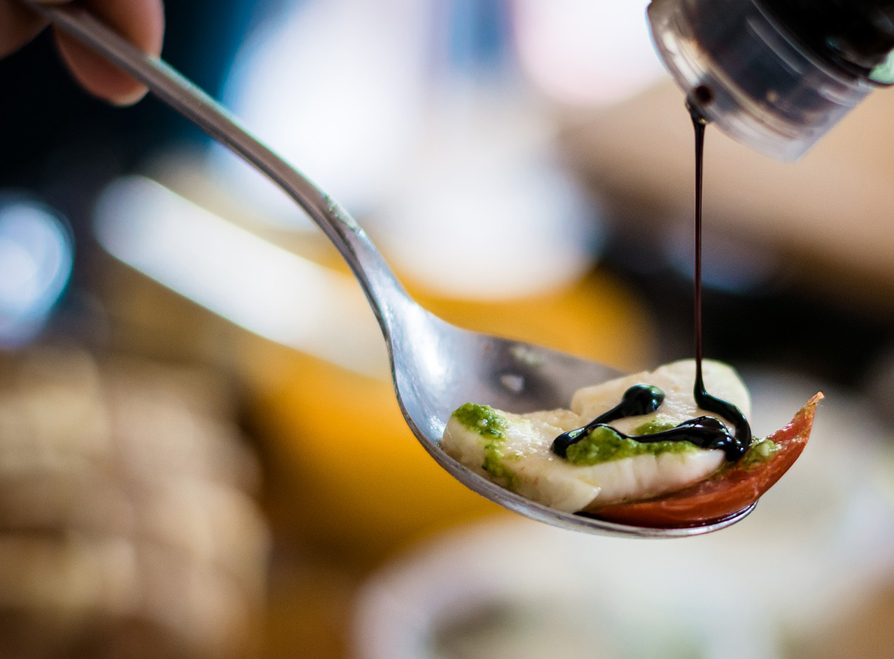
In cooking, the precious balsamic vinegar is often used drop by drop, served with. antipastoas Grana Padano D.O.P. cheese, or mortadella-balsamic vinegar is also used to season meat, eggs or grilled fish.
-
Balsamic vinegar also adds an exciting flavour to desserts and can be drizzled over strawberries, raspberries, pears or cream ice cream. A tiny amount of balsamic vinegar is also a great way to finish a meal.
If you’re missing a bottle of classic Italian balsamic vinegar from your kitchen cupboard, there’s a way out. Da Vinci e-shop. We wish you a great taste experience!