

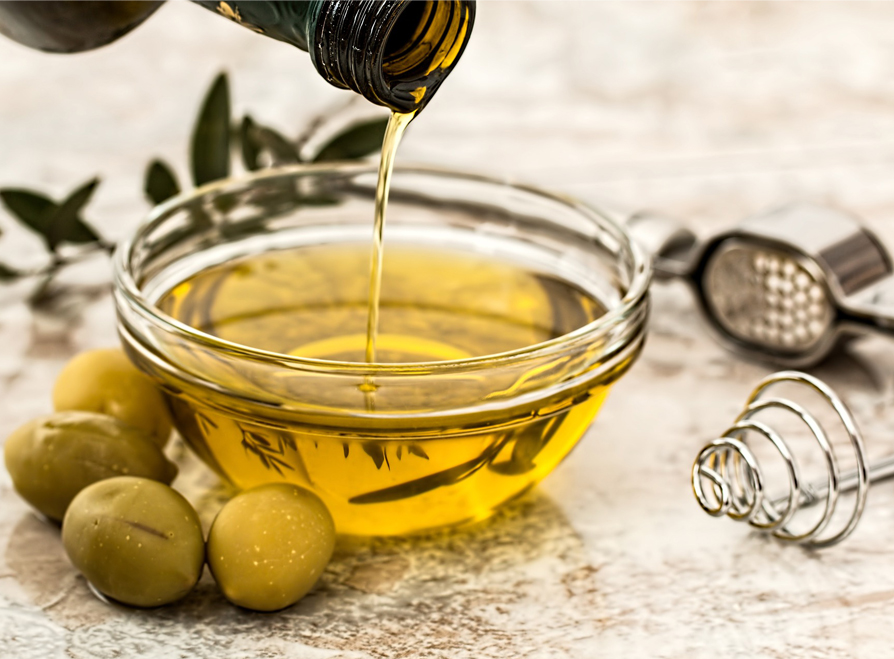
Olives and olive oil have been an integral part of Mediterranean cuisine for over 6000 years. Together with grapes and wheat, olives form the holy trinity of Mediterranean cuisine. They are also the basis for other staples of Mediterranean cuisine: wine, pasta, wheat flour and olive oil. In this article, we will take a closer look at olive oil, its different sub-types and its impact on our health.
The health benefits of the Mediterranean diet have been promoted for some time. In fact, olive oil is considered to be the key to this popular diet and the secret to its well-being. Of the nutrients, olive oil contains the highest levels of monounsaturated fatty acids (especially oleic acid), as well as fat-soluble vitamin E and vitamin K. Olive oil also contains polyphenols, which give untreated extra-virgin olive oil a slightly bitter off-flavour and act as antioxidants and anti-inflammatory compounds.
The consumption of olive oil, and extra-virgin olive oil in particular, is thought to have a number of health benefits. Here are some of the best known:
- Olive oil (and the Mediterranean diet as a whole) is thought to have a particularly positive effect on cardiovascular health. Research suggests that the high levels of monounsaturated fatty acids, polyphenols and antioxidants in olive oil play a major role.
- Olive oil helps maintain normal cholesterol levels. This effect is best achieved by replacing saturated fatty acids in the diet (especially animal foods and dairy products) with unsaturated fatty acids (e.g. oils, nuts and seeds).
- Regular consumption of olive oil is also thought to help reduce the risk of several other chronic diseases, including tumours. Polyphenols, which have antioxidant and anti-inflammatory properties, are likely to play an important role. Olive oil has also been found to help strengthen cell membranes, activate cells’ own defence systems and protect DNA.
- Studies have also shown the positive effects of olive oil in diabetes. In particular, olive oil consumption helps to keep blood glucose levels more even and triglyceride (fat) levels in the blood lower.
- Olive oil is also known to have anti-inflammatory effects, again attributed to the high polyphenol content of olive oil. It is thought that as little as 1-2 tablespoons of extra virgin olive oil per day can have a significant anti-inflammatory effect!
- Several polyphenols in olive oil also slow down the growth of undesirable bacteria in our gut, including those responsible for intestinal infections.
- Olive oil also has the ability to improve cognitive function (including e.g. visual memory and speech), especially in the elderly.
Olive oil is used in baking, frying and salads, but it’s also a good quality olive oil to simply eat with fresh chiabatta. In order to know which olive oil to choose, you need to know how one oil differs from another. Broadly speaking, olive oils can be classified into three broad categories:
Virgin olive oil labels indicate that only mechanical means have been used to extract the oil from the olives and that no chemical treatment has been used. Sh extra-virgin olive oil is of the highest quality and has the best flavour characteristics. The word ‘cold-pressed’ in the name refers to the fact that the oil is not heated above a certain temperature (usually 27 °C) during processing, which helps to retain more nutrients in the oil and improves its quality.
Refined olive oil is an oil obtained by refining virgin olive oil using various filters. The refining process removes the characteristic flavour, aroma and colour from the olive oil, leaving a very pure and neutral olive oil, colourless, odourless and tasteless. Oils known as pure olive oil or olive oil are often refined olive oils to which virgin olive oil has been added for flavour.
The last <10% of the oil remaining in the residue is extracted from the oil by chemical means such as solvents. Often the oil obtained in this way is also refined and virgin olive oil is added to achieve the right flavour. The result is olive pomace oil, which has the same fatty acid composition as ordinary olive oil.
In addition to the assessment of the oil’s flavour and aroma, the oil class is also largely differentiated by the free fatty acids present in the oil, more specifically the free oleic acid content. Notably, the free fatty acid content is lowest in extra virgin olive oil and higher in virgin and olive-pomace oils. In refined olive oil, the free fatty acid content has been chemically reduced even further to a lower level than in extra virgin oil. The lower the free fatty acid content of the oil, the higher the oil’s absorption point, i.e. the more resistant it is to heating.
Depending on the flavour of the olive oil, its chemical properties and the way it is obtained, the ways in which olive oils are used in cooking also vary. Extra virgin olive oil is a classic ingredient in salad dressings and garnishes, but can also be served simply with fresh Italian bread. Choosing a quality cold-pressed oil is often compared to choosing a wine: since each cold-pressed oil has its own personality and flavour bouquet, different oils go well with different foods.
By the way, the freshness of extra-virgin oil also plays a big role in its flavour. So, unless you use a significant amount of oil on a daily basis, it is often wiser to buy a smaller bottle of oil for the kitchen cupboard, which you can change more often if necessary. In this way, the flavour of the oil is better preserved. At home, there is also no need to store oil in the fridge, where it becomes grainy and thick at low temperatures. The temperature of a larder would be ideal, but a dark corner of the kitchen cupboard is also suitable.
It is good to know that although extra virgin olive oil can be used in frying, for example (i.e. it has a high absorption point), it is not a good idea to use it on a daily basis, especially because of the loss of flavour and some useful compounds when the oil is heated. Extra virgin oil can, if desired, be used, for example, for quick frying vegetables. At the same time, however, it should be borne in mind that many people are not used to the strong flavour of olive oil in fried foods.
For deep-frying, frying and stewing foods, it is better to use refined oils, where the refining process has reduced the free fatty acids to even lower levels than in extra-virgin oils. In this case, it should also be remembered that when cooking at home, it is a good idea to change the frying oil after each use. Olive-pomace oil is widely used in the food industry and is also well suited to cooking at elevated temperatures.
At Da Vinci e-shop you will find high quality olive oils straight from the heart of the Mediterranean. The range includes:
Two high quality Speroni extra-virgin olive oils, ideal for salads, fish, cooked vegetables and crispy bread.
Sansa Speroni olive pomace oil, ideal for baking (breads, muffins, pizzas), frying and deep-frying.
If you would like to share useful information about olive oil with others, feel free to use the share buttons at the bottom of the article.