

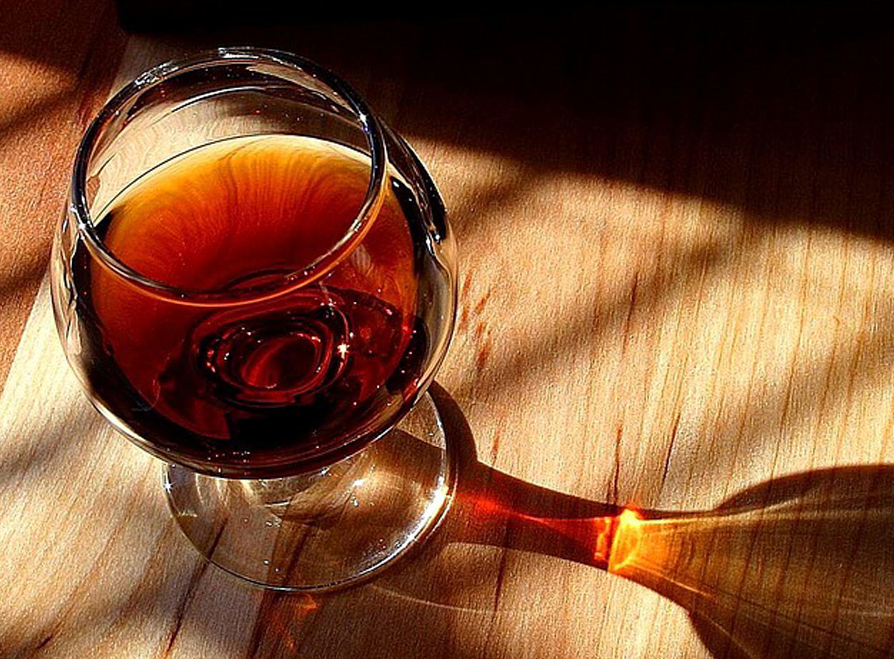
Port is a sweetly sparkling finale to a symphony of meals. It is the perfect accompaniment to a variety of desserts: red berries, ice cream, soft cheeses, foie gras, crème brulè, vanilla ice cream or apple pie. But why not also as a warming companion on cold winter days.
The family-run Quinta do Portal has been producing high quality port wines since the late 19th century.
Fine Ruby Port, 75 cl
Perfect with your favourite chocolate and soft cheeses. Dark purplish-red colour, incredibly fruity aroma and taste. A full-bodied and well-balanced young port wine made from Tinta Roriz, Touriga Franca, Tinta Barroca and Touriga Nacional grapes. Matured in the barrel for three years. Alcoholic strength: 19,5% and serving temperature: 14-16 °C. The product is available in our online shop: click here!
Portvein
The world can thank the French for this excellent wine. In fact, relations between the English and the French deteriorated to the point of war in 1702. As a result, the English could no longer get their favourite wine from Bordeaux. Something had to be found quickly to replace it. Encouraged by the Methuen Treaty of 1703, British wine merchants hoped to find a new Bordeaux in Portugal, inland from the town of Oporto in the Douro Valley. Although unsuccessful, failing to make a Bordeaux-style wine, a few buckets of brandy were added to the finished wine. This invented a whole new type of wine – fortified wine.
Later, it was found that adding wine distillate to the wine during fermentation resulted in a sweeter, higher quality wine. 19. In the middle of the 20th century, this style of winemaking became known all over the world and was widely used. Later it was discovered that different valleys and different banks produced completely different wines, and the further one went along the Douro towards Pinho, the steeper the slopes of the valley became, the vegetation became poorer and more fragile, while the wine became better and better. The soils are uneven and consist of granite and shale. For Port wine, the slate soils are considered the best. The best vineyards are on steeper slopes and on lower slopes near the river.
After harvesting, the grapes are taken to the wine cellar (quinta) and very often today to Vila Nova de Gaia. In the old days, wine was made in large open vessels or in large granite tanks (lagares). A vigorous initial fermentation lasts a few days, after which wine distillate is added to interrupt the fermentation process and raise the alcohol content of the wine to 19-20% and even 22%.
This leaves a good amount of sugars in the wine, as the cut-off is usually at 6%. In the old days, after fermentation, the wine was left to stand in the Douro wine cellars over the winter until the spring and was then transported by boat to the lodges, where the quality of the wine was determined, followed by blending (Vila Nova de Gaia). Port is almost always a blended wine. Port is always matured in oak barrels for at least two years, depending on the type of Port. Port wines are also blends of different vintages (except Vintage, LBV, Colheita).
Types of port:
– RUBY is young, ruby red in colour, fruity, sweet. It ripens in oak barrels for 2-5 years. It is sometimes produced without oak (in concrete or metal containers).
– TAWNY has been matured in cask for 7-40 years or more, blended with port. The colour is brick red, the taste is smooth and aromatic.
– VINTAGE is a vintage Port wine, made only in good years. It is aged in the barrel for two years and further ageing takes place in the bottle. Bottle ageing leads to sedimentation, which requires decanting. They are ready to drink at around 8-10 years of age, but can be kept for much longer – 40-50 years.
– LATE BOTTLED VINTAGE is a vintage port made from the best berries of the year. The wine is aged in cask for 4-6 years. Both the vintage and the year of bottling are indicated on the label.
– VINTAGE CHARACTER, VINTAGE RESERVE, VINTAGE STYLE are a blend of wines of medium quality from different years. Maturation takes place over many years in cask. No white wine is added.
– SINGLE QUINTA are port wines from a single garden, which can generally vary in age. The age class and the name of the garden must be indicated on the label. The value of these wines is constantly increasing. Also, the law is changing for these wines, i.e. they must be matured in the same quinta as the one indicated on the label, and this will greatly enhance their reputation. In other words, this is a future Chateau wine.
– CRUSTED, CRUSTING PORT is generally blended from the best port wines of 2-3 years. They are kept in cask for 3-4 years before bottling. A sediment (crust) forms in the bottle, hence the name.
– COLHEITA – this means that the harvesting takes place in Portugal. Which means, in effect, one vintage of Tawny port. The wine must be aged in cask for a minimum of 7 years and the year of harvest must be marked on the bottle.
– WHITE PORT, PORTO BRANCO – In 1935, white port began to be produced in the same way as red port. It uses light-coloured berries, the main one being the Mal-vasia. Fermentation is carried out by separating the skins. Sweet, dry and very dry. Dry, Semi Dry, Lagrima (sweet).
Da Vinci Food e-shop port wine selection – click here!
Attention! This is alcohol. Alcohol can damage your health!